
Hybrid Events: The Hidden Challenge of Fragmented Registration
Hybrid events promise the best of both worlds—physical attendance and online participation. Yet behind this flexibility lies a challenge that few organizers address early enough: fragmented attendee data.
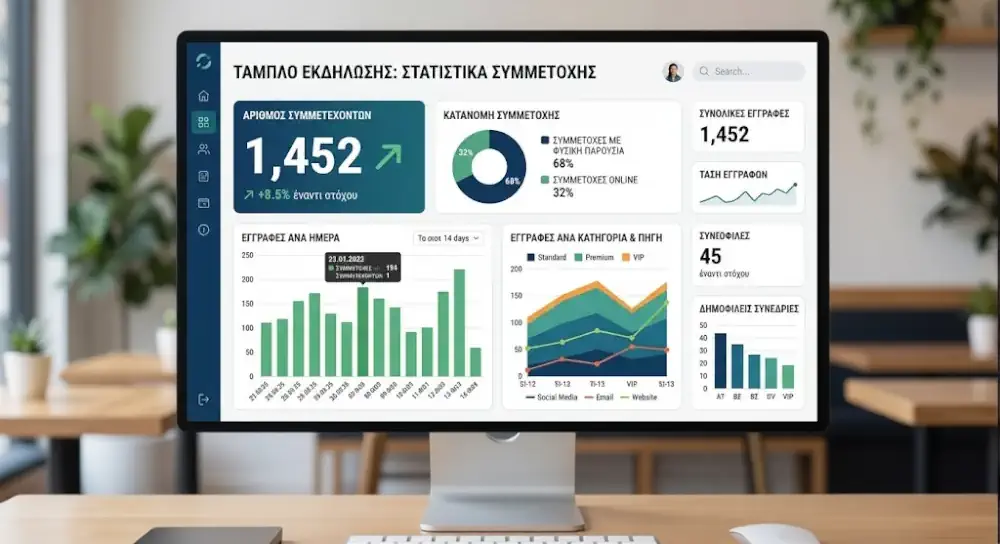
In practice, many hybrid events rely on two separate systems: one for on-site registration and check-in, and another for the streaming or webinar platform. The result is two parallel databases that rarely communicate in real time. An attendee who initially registered online but later decides to attend in person may be recorded twice, distorting attendance statistics.
This fragmentation is far more than an accounting issue. It directly impacts the attendee experience. Online participants cannot receive the same personalized communications as those attending on-site simply because the systems do not share a unified attendee profile. Likewise, sponsors seeking to evaluate audience engagement are left with two disconnected reports instead of a single comprehensive view.
The challenge grows when multiple internal teams are involved. IT manages the streaming platform, Marketing oversees registration, and Operations handles on-site check-in. Without a common data source, each team sees only part of the picture, leaving no one with a complete real-time view.
The solution is both technological and organizational. Organizations need a single source of truth—a unified attendee database where every participant has one unique profile regardless of how they attend. Achieving this requires designing the registration architecture around a unified data model from the outset rather than connecting incompatible systems later.
Equally important are clear internal processes: who is responsible for communicating attendance changes, how data is synchronized across teams in real time, and who ultimately owns the accuracy of reporting.
As hybrid events become the norm rather than the exception, the ability to unify registration data across every participation channel becomes a competitive advantage. Organizers who achieve this gain not only more accurate analytics but also the ability to deliver a truly seamless and personalized experience to every attendee, regardless of how they choose to participate.